The Limpopo River Basin (LRB) is home to an estimated 18 million people in the four Riparian States that share the basin – Botswana, Mozambique, South Africa, and Zimbabwe. Projections are that the population will reach over 20 million by 2040, putting evermore pressure on the transboundary water resources that support diverse socio-economic activities in the four countries.
The Basin, which has an estimated catchment area of about 408,000 km² is also under severe water stress, with the high level of hydro-climatic variability resulting in both frequent and intense floods and droughts, and the limited availability of water impacting the ecosystem's functioning, economic and social welfare of the basin's population, particularly that of poor and vulnerable groups. Key threats to the socio-economic and environmental services of the LRB include increasing water scarcity and hydrological variability, exacerbated by climate change, water quality degradation, land degradation, saline water intrusion on the flood plains, and increasing pressures on groundwater resources.
Improved water resources management, including the equitable allocation of water between upstream and downstream areas and among urban and rural users, is therefore, essential to counter the challenge in the basin and for the future development of the LRB. This is particularly important as there are several barriers already affecting basin-wide cooperation including limited institutional, technical, and financial capacity for joint planning and management at the transboundary basin level.
The Limpopo Watercourse Commission (LIMCOM) was established between the Republics of Botswana, Mozambique, South Africa and Zimbabwe through the LIMCOM Agreement signed in November 2003 in Maputo, Mozambique. With the formation of a permanent secretariat and various specialist task teams over the past decade, the organisation is now making strides to inform basin planning and activities to serve sustainable and equitable transboundary interests and objectives.
This session will approach the topic of 'knowledge management' to inform transboundary basin management and planning. In setting the scene in the Limpopo Basin and detailing research questions that LIMCOM has identified as critical scientific needs in the basin, it will solicit further research efforts. Importantly, this will also provide the opportunity for the water resources science community to provide their inputs and advice on themes they have identified of transboundary relevance for equitable and sustainable futures. Furthermore, this provides and important entry point for contributions from the scientific community into the upcoming Limpopo Transboundary Diagnostic Analysis (TDA) that subsequently will inform the development of Strategic Action Programme (SAP) for the LRB. Through this session the following will be explored:
Benefit sharing – in unlocking the transboundary research efforts then demonstrating the benefits of established RBOs and partners for generating and retaining capacity to member states while contributing in counter-balancing the array of prevailing challenges (socio-economic and environmental), the basin is faced with.
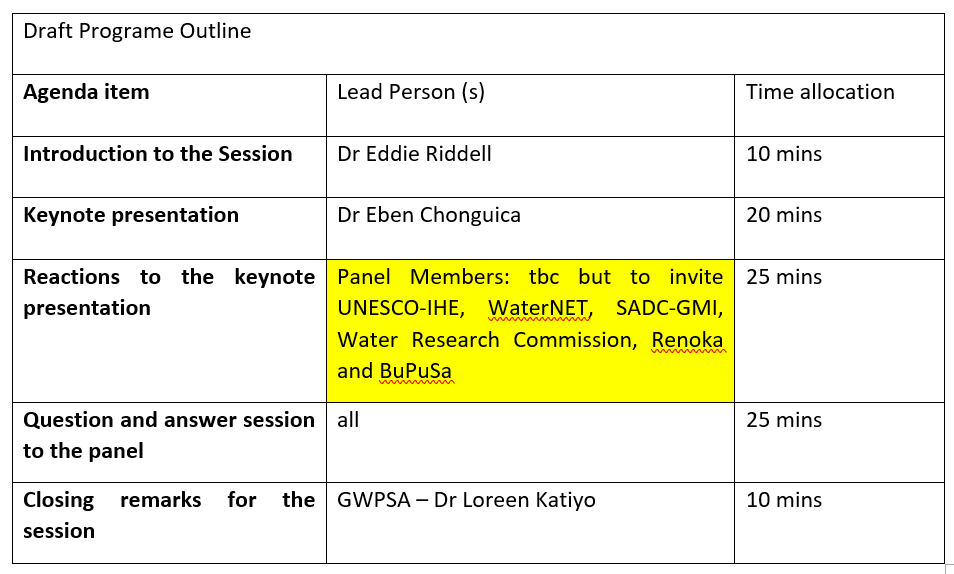
Programme
The Limpopo River Basin (LRB) is home to an estimated 18 million people in the four Riparian States that share the basin – Botswana, Mozambique, South Africa, and Zimbabwe. Projections are that the population will reach over 20 million by 2040, putting evermore pressure on the transboundary water resources that support diverse socio-economic activities in the four countries.
The Basin, which has an estimated catchment area of about 408,000 km² is also under severe water stress, with the high level of hydro-climatic variability resulting in both frequent and intense floods and droughts, and the limited availability of water impacting the ecosystem's functioning, economic and social welfare of the basin's population, particularly that of poor and vulnerable groups. Key threats to the socio-economic and environmental services of the LRB include increasing water scarcity and hydrological variability, exacerbated by climate change, water quality degradation, land degradation, saline water intrusion on the flood plains, and increasing pressures on groundwater resources.
Improved water resources management, including the equitable allocation of water between upstream and downstream areas and among urban and rural users, is therefore, essential to counter the challenge in the basin and for the future development of the LRB. This is particularly important as there are several barriers already affecting basin-wide cooperation including limited institutional, technical, and financial capacity for joint planning and management at the transboundary basin level.
The Limpopo Watercourse Commission (LIMCOM) was established between the Republi ...
Virtual 2 24th WaterNet/WARFSA/GWPSA Symposium waternet@waternetonline.orgTechnical Issues?
If you're experiencing playback problems, try adjusting the quality or refreshing the page.
Questions for Speakers?
Use the Q&A tab to submit questions that may be addressed in follow-up sessions.